Reading a bill of materials like a buyer
Your BOM is a forecast of every supply problem you will have in two years. Most founders never read it that way.
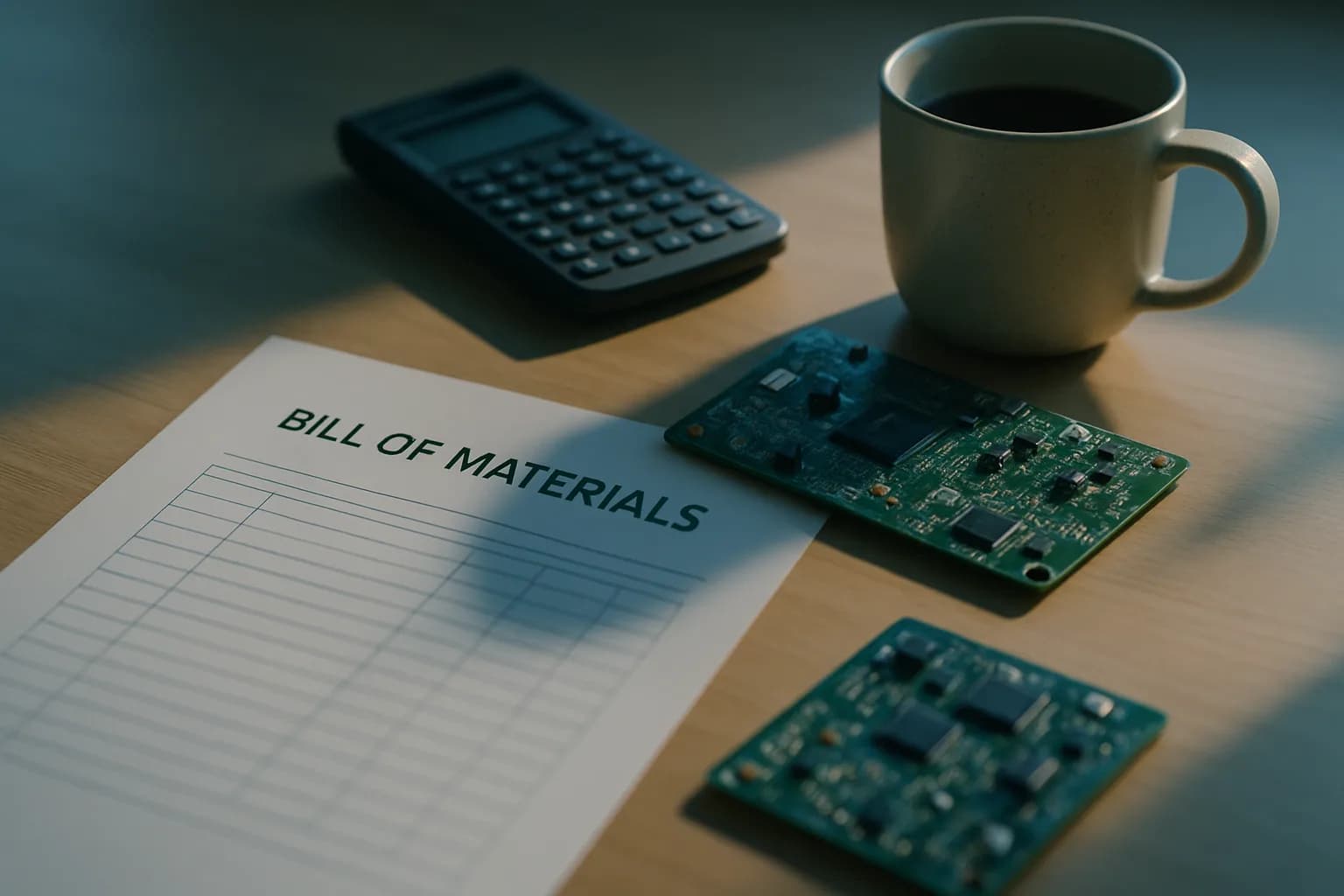
Most founders read a bill of materials as a cost sheet. It is also a risk register, a schedule and a forecast of every supply problem the product will have for as long as it is sold. Read it that way and it tells you a great deal.
Four columns that are not price
For each line, the questions that matter are rarely about unit cost:
- Is there a second source? A part from one manufacturer, in one package, is a single point of failure for the whole product.
- What is the lead time, and is it stable? A part with a long lead time sets the pace of every production run.
- What is the lifecycle status? A component already marked for end-of-life will need a redesign, and it is cheaper to know now.
- What is the minimum order quantity? A cheap part with a large minimum can be more expensive than a dearer one, at your volume.
Cost is a curve, not a number
A bill of materials priced at ten thousand units says nothing useful about a first run of five hundred. Component pricing steps at quantity breaks, tooling amortises across volume, and assembly cost per unit falls as a line settles.
The useful artefact is the same bill costed at three volumes — the first run, the expected year one, and the optimistic case. The shape of that curve tells you where the product becomes viable, which is usually the number a founder actually needs.
The lines that are not parts
Bills of materials also tend to omit the things that are not components: test time, packaging, freight, duty, scrap and the yield loss that any real process has. Left out, they appear later as a margin that is smaller than the spreadsheet promised.
It is better to carry them from the start, even as rough allowances. A slightly pessimistic number you planned for is easier to live with than an accurate one that arrives as a surprise.
Working on something like this?
We design and manufacture hardware end to end. The first call is with an engineer and costs nothing.